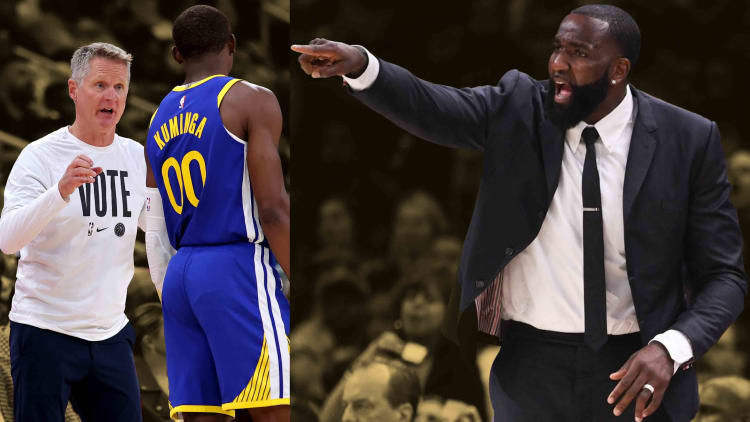
Steve Kerr is the problem. Period” – Kendrick Perkins sounds off on who’s really to blame for the Kuminga situation in Golden State
Steve Kerr Is the Problem. Period”: Perkins Blasts Warriors Coach Over Kuminga Standoff

In what’s quickly become one of the most heated debates in the NBA this season, former NBA champion and current analyst Kendrick Perkins hasn’t held back in his criticism of Golden State Warriors head coach Steve Kerr. Perkins has pointed the finger squarely at Kerr — not the players — as the reason why the Warriors’ relationship with Jonathan Kuminga has devolved into one of the league’s biggest storylines this season.
The Spark: Kuminga’s Role Reduced and Trade Rumors Rising
Jonathan Kuminga, a former lottery pick and one of the league’s most intriguing young talents, finds himself in a precarious position. Once a starter and key rotational piece, Kuminga has suddenly seen his minutes shrink — and at times hasn’t played at all — even as the Warriors continue to search for consistency. The situation reached a flashpoint when Kuminga became eligible to be traded, and a trade request reportedly loomed.
With the Warriors’ record less than stellar and lineup experimentation rife, critics argue that the team’s identity has become muddled. Observers — including analysts and fans alike — have pointed to the Kuminga saga as a symptom of deeper dysfunction.
Perkins’s Stance: Blame Kerr, Not Kuminga
During a recent episode of the popular “Road Trippin’” podcast, Perkins didn’t mince words. He asserted that Steve Kerr’s handling of Kuminga’s development and role is fundamentally flawed.
> “Steve Kerr is the problem. Period,” Perkins declared emphatically, arguing that while Kerr trusts other young wings like Brandon Podziemski and Moses Moody, he simply hasn’t afforded Kuminga the same faith.
Perkins believes that belief from a coach is essential to a young player’s success — a point he underscored with a personal example from his own career. When Doc Rivers trusted Perkins as a young player in Boston, it helped fuel his confidence and eventual championship run in 2008.
For Perkins, that trust appears to be missing in the Warriors organization when it comes to Kuminga. He contends that Kyle Podziemski and other young roster pieces have received clearer paths and more opportunities, while Kuminga has frequently been benched or sidelined entirely — even during stretches when the team could use his athleticism and defensive impact.
Not Just Kerr? Other Voices in the Debate
Perkins’s comments ignited even more attention because they weren’t the only voices questioning Golden State’s handling of its young star. On the same podcast, co‑host Channing Frye argued that the blame also lies with the front office, specifically General Manager Mike Dunleavy Jr. Frye suggested that while Kuminga might not fit seamlessly into the Warriors’ system — which is centered around Stephen Curry’s unique skill set — that only underscores why a trade might be wise.
“Why keep him there?” Frye asked. “If it’s clear he’s not a fit, you have to move him.”
In other words, while Perkins highlighted coaching philosophy and trust, Frye pointed to roster construction and systemic fit as central issues.
Warriors Organization and Kerr’s Response
Meanwhile, Steve Kerr himself has largely taken a hands‑off approach in public comments. When asked about the Kuminga situation, Kerr described it as “a difficult situation” and avoided laying out specifics. He has reiterated that Kuminga is a valuable young player and that the organization must stay focused despite the noise surrounding trade eligibility and rotation decisions.
Kerr’s guarded comments reflect the broader challenge teams face when balancing player development, veteran leadership, and the pressures of winning now — especially in an era where the league is a mix of superstars and emerging talent.
Is It Really Just About Kerr? Broader Criticism Emerges
Perkins isn’t alone in criticizing the Warriors’ management of young talent under Kerr. Sports media reports and discussions from other former players have noted that the head coach’s systems may not lend themselves easily to developing dynamic, high‑athleticism players who don’t fit the traditional mold.
For instance, other commentators have pointed to younger players like James Wiseman — another former high draft pick — as examples of top prospects whose careers stalled under similar circumstances. Critics argue this highlights a pattern rather than an isolated case.
Additionally, social media conversations among fans and analysts echo frustrations about Kerr’s unwillingness to adapt his core offensive principles, sometimes at the expense of utilizing a physically gifted player like Kuminga. Some posts suggest that cultural factors — such as reliance on veteran systems or expectations about basketball IQ — play into why coaches like Kerr hesitate to entrust young players with expanded roles.
The Warriors’ Current State: A Team at a Crossroads
Beyond the coaching debate, the Warriors’ overall trajectory is under scrutiny. With veterans like Stephen Curry, Draymond Green, and Jimmy Butler anchoring the team’s leadership and production, the franchise faces the dual challenge of maximizing current success while also planning for the future. Critics, including Perkins, argue that the balance has tipped too far toward experience and not enough toward cultivating the next generation.
Perkins has even lamented that the organization seems “broken,” arguing that the dysfunction isn’t limited to Kerr but ricochets through the roster and front office. He’s said that the Warriors — once a model franchise — don’t have a clear plan that marries present competitiveness with future sustainability.
What Happens Next: Deadline Decisions and Beyond
With the trade deadline approaching, the Kuminga situation is likely to force a decision. Golden State can choose to reintegrate Kuminga — offering him the playing time and role clarity he’s been lacking — or they can pursue a trade that could reshape the roster. Analysts believe the latter is increasingly likely unless a clear turnaround occurs in the next few weeks.
Either way, the outcomes will influence not just the remainder of this season but the Warriors’ long‑term identity. If a trade happens, it could signal that the championship window with Curry and Green has slid further out than anticipated. If Kuminga stays and flourishes, it may vindicate voices like Perkins who have argued that the team must trust its young talent.
Conclusion: Coaching, Culture, or Something Else?
At the heart of this controversy is a deeper question about what kind of team the Warriors want to be. Kendrick Perkins’s bold claim that “Steve Kerr is the problem” may be controversial, but it underscores a broader unease among fans and analysts about Golden State’s strategy. Whether the issue is coaching philosophy, personnel decisions, or a mix of both, one thing is clear: the Kuminga saga has become a defining storyline of the Warriors’ season — and a litmus test for how elite NBA franchises manage talent, culture, and expectations in a fast‑evolving league.