NFL Rookie Minicamps Set to Kick Off as 2026 Draft Class Begins First Taste of Professional Football
NFL Rookie Minicamps Set to Kick Off as 2026 Draft Class Begins First Taste of Professional Football
As the NFL offseason continues to unfold, attention is shifting toward one of the most anticipated early milestones for incoming players: rookie minicamps. These sessions, scheduled to begin in early May across all 32 franchises, mark the first official step into professional football for drafted rookies, undrafted free agents, and tryout players hoping to earn a roster spot.
For many young athletes, this moment represents more than just football drills and playbooks—it is the beginning of a career dream that has been years in the making. Teams, meanwhile, view rookie minicamps as an early evaluation ground where potential, adaptability, and mental readiness are tested in a controlled environment.
This year’s rookie minicamps carry added intrigue due to a highly discussed 2026 draft class, a wave of new coaching strategies across several franchises, and increased competition at key positions such as quarterback, wide receiver, and defensive back.
—
What Rookie Minicamps Actually Are
Rookie minicamps are short training sessions organized by NFL teams shortly after the draft. They typically last between three and five days and serve multiple purposes.
First, they help rookies transition from college football systems to NFL-level schemes. Even the most talented college players often struggle initially with the complexity and speed of professional playbooks.
Second, they allow coaching staffs to evaluate how quickly players absorb information. The NFL is not just about athletic ability; mental processing, discipline, and decision-making often determine whether a player survives roster cuts.
Third, these camps include undrafted free agents and tryout players. For them, rookie minicamps are a rare opportunity to impress coaches and earn a contract before training camp begins.
Finally, teams use these sessions to introduce rookies to organizational culture, expectations, and professionalism standards. From nutrition plans to media responsibilities, everything begins here.
—
The Importance of Early Impressions
In the NFL, first impressions matter significantly. While rookie minicamps do not determine final roster spots, they can strongly influence a player’s trajectory.
Coaches are watching for several key traits:
Football intelligence: How quickly a player learns assignments
Work ethic: Effort during drills and meetings
Physical readiness: Conditioning and injury resilience
Communication: Ability to adjust and take coaching feedback
Consistency: Repeating correct techniques under pressure
A strong performance in rookie minicamp can position a player for increased reps during training camp, while a poor showing may force them into an uphill battle for attention.
—
Quarterbacks Under the Spotlight
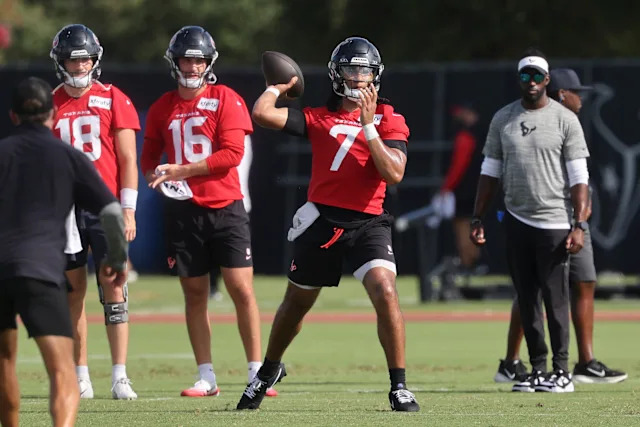
As always, quarterbacks will draw the most attention during rookie minicamps. Every NFL franchise invests heavily in evaluating its signal-callers, and rookie minicamp is the first chance to see how draft picks adjust to professional defenses.
Rookie quarterbacks must quickly adapt to:
Faster defensive reads
More complex blitz packages
Tight throwing windows
Increased expectations for leadership
Even highly drafted quarterbacks often struggle early, but minicamps provide a safe learning environment. Coaches are less focused on results and more on decision-making, mechanics, and command of the huddle.
For undrafted quarterbacks, however, the stakes are higher. Many are simply fighting to be invited to training camp, making every throw critical.
—
Wide Receivers and Timing Chemistry
Wide receivers also face a steep adjustment period. Unlike college systems, NFL offenses require precise timing, disciplined route running, and chemistry with quarterbacks who are still learning their tendencies.
Rookie minicamp is often the first time receivers run full-speed routes with their new team’s quarterback. Miscommunication is common, but improvement across sessions is what coaches look for.
Key areas of evaluation include:
Route precision
Separation from defenders
Catching consistency
Ability to adjust mid-route
Blocking effort in run plays
Speed alone is no longer enough in the NFL. Receivers must prove they understand spacing and defensive manipulation.
—
Defensive Players Learning Complexity
On defense, rookie minicamps can be overwhelming. Defensive schemes in the NFL are significantly more complex than in college, with layered coverages, disguised blitzes, and rapid in-play adjustments.
Defensive backs, in particular, face one of the toughest transitions. They must learn to read quarterbacks faster, anticipate route combinations, and maintain discipline against elite receivers.
Linebackers and defensive linemen also undergo evaluation based on:
Gap discipline
Reaction speed
Play recognition
Technique refinement
Communication within defensive units
Coaches often prioritize mental processing over raw athleticism at this stage.
—
Undrafted Free Agents: The Hidden Battle
While drafted rookies receive guaranteed opportunities, undrafted free agents enter minicamps with little security. For many, this is their only chance to impress NFL scouts in person.
These players often come from smaller programs or had limited exposure during the draft process. Despite that, every year multiple undrafted players manage to earn roster spots or practice squad positions.
Their success stories usually depend on:
Special teams ability
Versatility across positions
High football IQ
Exceptional effort and discipline
Rookie minicamp becomes a proving ground where effort can sometimes outweigh draft status.
—
Coaching Staff Evaluation Goals
For coaching staffs, rookie minicamps are about more than player performance. They also serve as a diagnostic tool for the organization itself.
Coaches evaluate:
How well rookies absorb coaching language
Whether schemes are being taught clearly
Early chemistry between position groups
Communication effectiveness across staff
Teams often adjust terminology or simplify certain concepts after rookie minicamp if players struggle with comprehension. In that sense, these camps help refine the entire offseason structure.
—
The Physical and Mental Transition to the NFL
One of the most underestimated aspects of rookie minicamp is the physical and mental jump from college to the NFL.
Players often describe the experience as a shock due to:
Faster game speed
Higher physical intensity
More demanding practice schedules
Increased attention to detail
Mentally, rookies must also adjust to being fully responsible professionals. There is no college structure guiding them anymore—nutrition, recovery, and preparation become individual responsibilities.
Many teams assign veterans or position coaches to help rookies adjust during these early stages.
—
Media Attention and Early Expectations
Although rookie minicamps are not heavily publicized compared to training camp or regular season games, media coverage still plays a role. Fans are eager to see highlights, early depth chart projections, and standout performers.
However, teams often caution against overreacting to minicamp performances. A standout rookie in early May may not necessarily translate into a successful regular season player.
Still, narratives often begin forming here, especially for first-round picks or quarterbacks expected to start early in their careers.
—
What Comes After Rookie Minicamps
Once rookie minicamps conclude, teams transition into organized team activities (OTAs), followed by mandatory minicamps and full training camp later in the summer.
Each phase increases in intensity:
1. Rookie minicamp – introduction and evaluation
2. OTAs – integration with veteran players
3. Mandatory minicamp – full team installation
4. Training camp – roster battles and preseason preparation
By the time the regular season begins, most roster decisions are finalized, but rookie minicamp often sets the foundation for those outcomes.
—
Final Outlook
As rookie minicamps begin across the league, excitement builds for fans and franchises alike. While these sessions are short and relatively low-pressure compared to the regular season, their importance should not be underestimated.
They represent the first step into the professional world for hundreds of young athletes and the beginning of roster shaping for all NFL teams. Coaches will be watching closely, players will be learning quickly, and every rep will matter more than it appears on the surface.
For the 2026 rookie class, this is where potential starts turning into reality—and where NFL careers quietly begin.





![Kiedy Iga Świątek zagra z Qinwen Zheng? O której godzinie odbędzie się mecz? US Open [TRANSMISJA]](https://sportdomain.com.ng/wp-content/uploads/2026/09/images-22-1.jpeg)